
Introduction
Forex charts look confusing at first. You see colorful lines, green and red candles, and many numbers. But reading a Forex chart is not as hard as it looks. In this article, I will teach you how to read Forex charts in simple words. By the end, you will understand what the chart is telling you.
What is a Forex Chart?
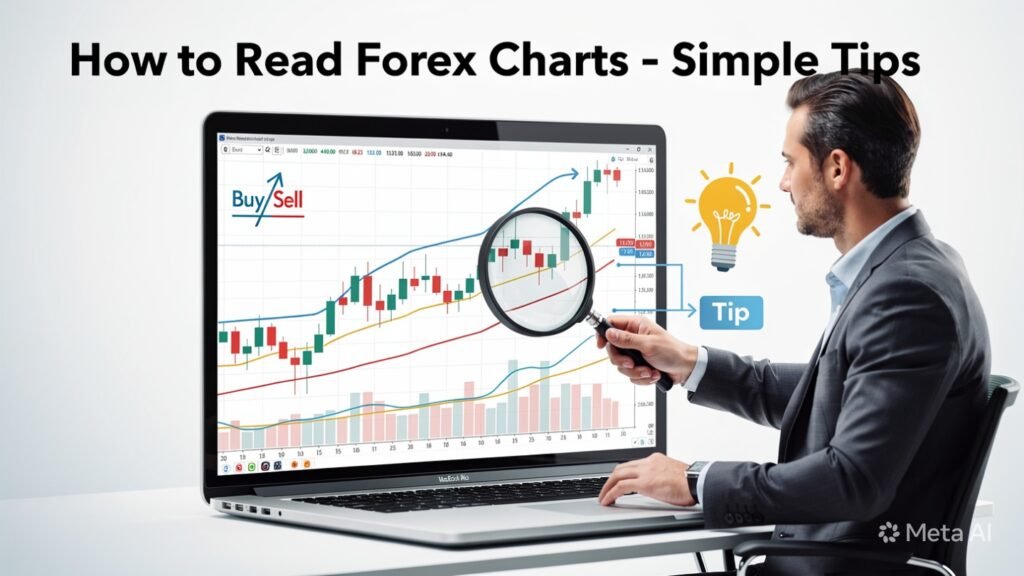
A Forex chart is a picture of how a currency pair’s price has moved over time. It shows you:
- Past prices
- Current price
- Whether prices are going up or down
Think of it like a map. The chart helps you decide where the price might go next.
Three Types of Forex Charts
There are three main types of charts. Here is what they look like:
| Chart Type | What It Looks Like | Best For |
| Line chart | A simple line connecting prices | Seeing the big picture |
| Bar chart | Vertical bars with high/low prices | Detailed information |
| Candlestick chart | Green and red “candles” with wicks | Beginners (most popular) |
Best for beginners: Candlestick chart. It is the easiest to read and gives the most information.
How to Read a Candlestick Chart
A candlestick has three parts:
- Body – The thick part showing open and close prices
- Wick (or shadow) – The thin line above and below showing high and low prices
- Color – Tells you if price went up or down
Candlestick colors:
| Color | Meaning |
| Green (or white) | Price went UP (bullish) |
| Red (or black) | Price went DOWN (bearish) |
What one candlestick tells you:
- Open price – where the candle started
- Close price – where the candle ended
- High price – highest point reached
- Low price – lowest point reached
Simple Example
Imagine a green candlestick on EUR/USD:
- Open = 1.1000
- Close = 1.1050
- High = 1.1060
- Low = 1.0990
What this means: Price started at 1.1000, went up to 1.1050, touched a high of 1.1060, and a low of 1.0990. Since it is green, buyers were stronger than sellers.
Timeframes – How Much Time Each Candle Shows
You can choose different timeframes. Each candle represents a different amount of time.
| Timeframe | Each candle shows | Best for |
| 1 minute (M1) | 1 minute of price movement | Very fast trading (not for beginners) |
| 5 minutes (M5) | 5 minutes | Day trading |
| 15 minutes (M15) | 15 minutes | Day trading |
| 1 hour (H1) | 1 hour | Good for beginners |
| 4 hours (H4) | 4 hours | Swing trading |
| 1 day (D1) | 1 full day | Long-term trading |
Beginner advice: Start with the 1-hour (H1) chart. It is not too fast and not too slow.
Support and Resistance – Two Most Important Concepts
Support – A price level where the price stops falling and bounces UP. Think of it like a floor.
Resistance – A price level where the price stops rising and bounces DOWN. Think of it like a ceiling.
How to find support and resistance on a chart:
- Look left on the chart
- Find prices where the chart bounced many times
- Draw a horizontal line there
- That is support or resistance
Trend – Which Direction is Price Moving
The trend is the overall direction of price.
| Trend | Description | What to do |
| Uptrend | Higher highs and higher lows | Look to BUY |
| Downtrend | Lower highs and lower lows | Look to SELL |
| Sideways (range) | Price moves flat | Wait, do not trade |
Simple way to spot trend: Look at the last 20-50 candles. Are they mostly green (uptrend) or mostly red (downtrend)?
Simple Chart Reading Checklist for Beginners
Before you take a trade, ask these questions:
- What is the current trend? (Up, down, or sideways?)
- Is price near support or resistance?
- Am I trading with the trend or against it? (Trading with the trend is easier)
Common Chart Reading Mistakes
| Mistake | Why It Is Bad |
| Using too many indicators | Confuses you. Start with just price and trend. |
| Looking at very small timeframes | Too much noise. Stick to H1 or H4. |
| Ignoring the trend | Trading against the trend is very hard. |
| Not practicing on demo | Charts become easier with practice. |
Practice Exercise
Open a demo account. Look at the EUR/USD chart on H1 (1-hour) timeframe. Answer these questions:
- What is the current trend?
- Where is the nearest support?
- Where is the nearest resistance?
Do this every day for 2 weeks. You will become comfortable with charts very fast.
Conclusion
Reading Forex charts is a skill. It takes practice. Start with candlestick charts on the H1 timeframe. Learn to spot trends, support, and resistance. Do not use too many indicators. Practice on a demo account every day. Within one month, you will read charts like a beginner pro.