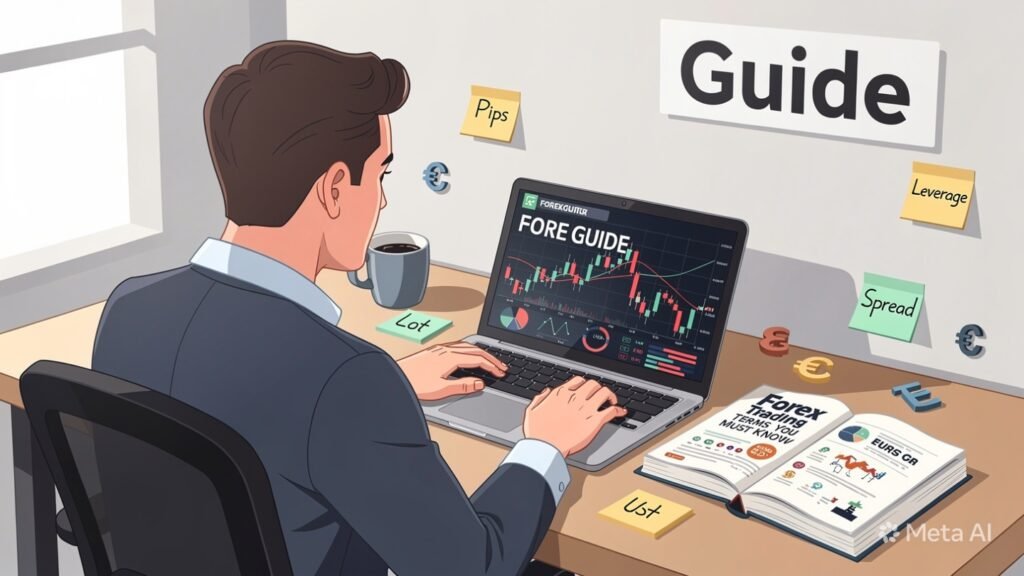

When you start learning Forex trading, you will hear many new words. Terms like “pip,” “spread,” “leverage,” and “margin” may sound confusing. Do not worry. In this article, I will explain the most important Forex trading terms in very simple words. Learn these terms, and you will understand 90% of beginner Forex conversations.
1. Currency Pair
A currency pair is two currencies traded together. Forex always trades in pairs because you buy one currency and sell another.
Example: EUR/USD
- EUR = Euro (base currency)
- USD = US Dollar (quote currency)
Common currency pairs for beginners:
| Pair | Name |
| EUR/USD | Euro / US Dollar |
| GBP/USD | British Pound / US Dollar |
| USD/JPY | US Dollar / Japanese Yen |
| USD/CAD | US Dollar / Canadian Dollar |
2. Base Currency and Quote Currency
In any currency pair:
- Base currency = First currency (left side)
- Quote currency = Second currency (right side)
Example: EUR/USD = 1.10
- 1 Euro (base) = 1.10 US Dollars (quote)
3. Pip
Pip means “Percentage in Point.” A pip is the smallest price move a currency pair can make. For most pairs, 1 pip = 0.0001.
Example: EUR/USD moves from 1.1050 to 1.1051
That is a movement of 1 pip.
Why are pips important? Your profit or loss is measured in pips.
4. Spread
Spread is the difference between the buy price (ask) and the sell price (bid). The spread is how the broker makes money.
Example:
- Buy price (ask) = 1.1050
- Sell price (bid) = 1.1048
- Spread = 0.0002 (2 pips)
What beginners should know: Lower spread = lower cost for you.
5. Lot
A lot is the size of your trade. Think of it like “how many eggs you buy.”
| Lot Type | Size | Good for |
| Standard lot | 100,000 units | Professionals |
| Mini lot | 10,000 units | Intermediate |
| Micro lot | 1,000 units | Beginners |
| Nano lot | 100 units | Very small accounts |
Beginner advice: Always start with micro lots or nano lots.
6. Leverage
Leverage is like a loan from your broker. It allows you to control more money than you have.
Example: Leverage 1:100
- You have $100
- You can control $10,000
Warning: Leverage increases both profit AND loss. High leverage is very risky for beginners.
7. Margin
Margin is the amount of money you need to keep in your account to open a trade. It is like a security deposit.
Example: You want to trade $10,000 with 1:100 leverage
- You need $100 margin (1% of $10,000)
8. Stop-Loss (SL)
A stop-loss is an order that automatically closes your trade when the price reaches a certain loss level. It protects your money.
Example: You buy EUR/USD at 1.1000 and set stop-loss at 1.0950
If price falls to 1.0950, your trade closes automatically. You only lose 50 pips, not more.
Rule: Always use a stop-loss on every trade.
9. Take-Profit (TP)
A take-profit is an order that automatically closes your trade when the price reaches a certain profit level.
Example: You buy EUR/USD at 1.1000 and set take-profit at 1.1100
If price rises to 1.1100, your trade closes automatically. You lock in your profit.
10. Bull Market and Bear Market
| Term | Meaning |
| Bull market | Prices are going UP |
| Bear market | Prices are going DOWN |
Easy way to remember: Bull pushes horns UP. Bear claws DOWN.
11. Long and Short
| Term | What it means |
| Going Long | You BUY first, SELL later (expect price to go up) |
| Going Short | You SELL first, BUY later (expect price to go down) |
12. Demo Account
A demo account is a practice account with fake money. You can trade without risking real money. Every beginner should start with a demo account.
Quick Summary Table
| Term | Simple Meaning |
| Currency pair | Two currencies traded together |
| Pip | Smallest price move |
| Spread | Difference between buy and sell price |
| Lot | Trade size |
| Leverage | Borrowed money to trade bigger |
| Margin | Deposit needed to open a trade |
| Stop-loss | Automatic close to limit loss |
| Take-profit | Automatic close to lock profit |
| Long | Buy first, sell later |
| Short | Sell first, buy later |
| Demo account | Practice with fake money |
Conclusion
You do not need to memorize all these terms today. Save this article and read it again later. Start with a demo account, and you will learn these terms naturally as you practice.
Most important terms for beginners: Pip, Spread, Leverage, Stop-loss, and Demo account. Master these five first, and you will be ready to start.