
Introduction
Every new Forex trader makes mistakes. That is normal. But some mistakes can cost you a lot of money. The good news is: you can learn from other people’s mistakes instead of making them yourself. In this article, I will tell you the 7 most common Forex trading mistakes beginners make and how to avoid each one.
Mistake #1: Trading Without a Demo Account First
Many beginners open a real account and start trading with real money immediately. This is like learning to drive a car on a busy highway. You will crash.
How to avoid it:
Practice on a demo account for at least 2-4 weeks. Use fake money. Learn how the platform works. Make all your beginner mistakes with fake money.
Mistake #2: Risking Too Much Money on One Trade
Some beginners put 50% or even 100% of their account on one trade. If the trade goes wrong, they lose everything. This is called “gambling,” not trading.
How to avoid it:
Follow the 1-2% rule. Never risk more than 1-2% of your account on a single trade. If you have $200, risk only $2-$4 per trade.
Mistake #3: Not Using a Stop-Loss
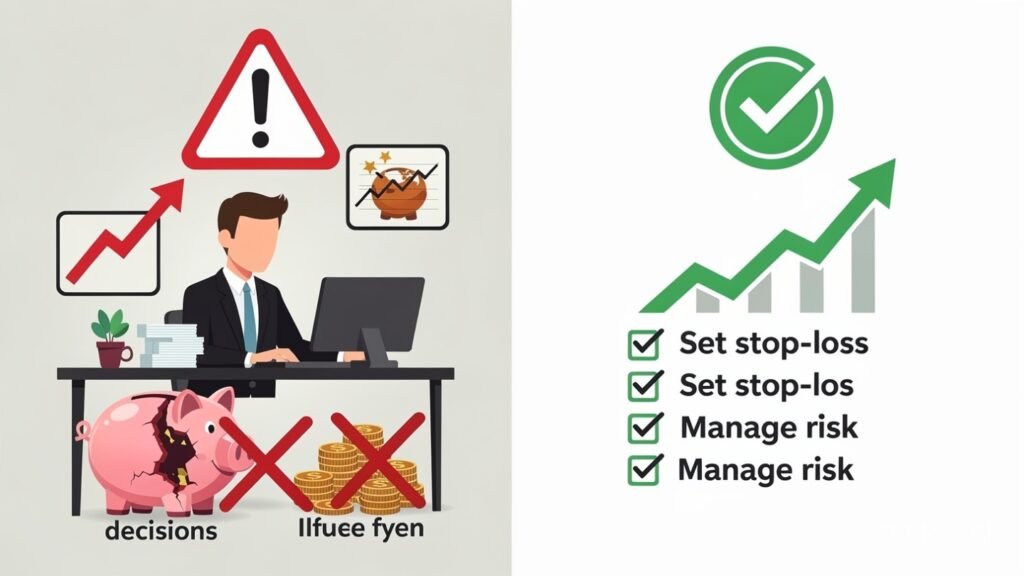
A stop-loss is a tool that automatically closes your trade if the price goes against you by a certain amount. Many beginners do not use it because they think the price will come back. Sometimes it does not come back, and they lose everything.
How to avoid it:
Always set a stop-loss on every trade before you click “buy” or “sell.” Never trade without one.
Mistake #4: Overtrading – Trading Too Much
Some beginners trade 10-20 times per day. They feel excited and cannot stop. Overtrading leads to tiredness, bad decisions, and losses.
How to avoid it:
Set a limit. Trade only 1-3 times per day maximum. Take breaks. Walk away from the screen after 1-2 hours.
Mistake #5: Revenge Trading – Trying to Get Back Lost Money
You lose $20 on a trade. You feel angry. So you open another trade immediately to win back the $20. Then you lose another $20. Then you try again… and lose again. This is called revenge trading, and it is very dangerous.
How to avoid it:
Accept that losses are normal. If you lose, stop trading for the day. Take a walk. Come back tomorrow with a fresh mind.
Mistake #6: Trading Without a Plan
Many beginners wake up, open their trading platform, and just guess “up” or “down.” This is not trading. This is gambling.
How to avoid it:
Make a simple trading plan:
- Which currency pair will I trade today?
- At what price will I enter?
- Where will I put my stop-loss?
- Where will I take profit?
- How much money will I risk?
Write these down before every trade.
Mistake #7: Using Too Much Leverage
Leverage is like a loan from your broker. It lets you trade more money than you have. For example, with 1:100 leverage, $100 can control $10,000. Leverage can give you big profits, but it can also give you very big losses very fast.
How to avoid it:
As a beginner, use low leverage – 1:10 or 1:20 maximum. Never use 1:500 or 1:1000. And always use a stop-loss.
Quick Summary Table of Mistakes and Solutions
| Mistake | Solution |
|---|---|
| No demo account practice | Practice 2-4 weeks on demo first |
| Risking too much per trade | Risk only 1-2% per trade |
| No stop-loss | Always set a stop-loss |
| Overtrading | Trade only 1-3 times per day |
| Revenge trading | Stop trading for the day after a loss |
| No trading plan | Write a simple plan before each trade |
| Too much leverage | Use low leverage (1:10 to 1:20) |
Conclusion
Mistakes are part of learning. But you do not need to make every mistake yourself. Learn from this list:
- Practice on a demo account first.
- Risk only 1-2% per trade.
- Always use a stop-loss.
- Do not overtrade.
- Never revenge trade.
- Make a trading plan.
- Use low leverage.
If you avoid these 7 mistakes, you will be ahead of 90% of new traders. Forex trading is a journey. Be patient. Learn slowly. And protect your money first.